
“When I can no longer rise to the occasion, I find I can fall into place.” Sarah-Jane Menato
After an extended five year cycle of personal loss and bereavement that included the death of my Mother and a diagnosis of an autoimmune condition, I came to a point where I could no longer rise to the occasion. Unexpectedly, I found I fell into place. As inner and outer structures of both cultural and personal identity collapse, there is potential, I’ve found, in the dust and ruins of what has been, to experience “falling into place”.
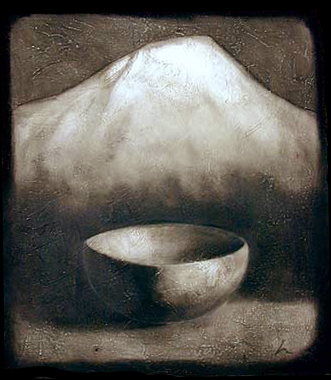
Bowl and Mountain by Don Hazeltine
External demands to continually “rise and transcend” can deeply compromise vital inner territory of “home” and being “in place”. Repeatedly “rising to the occasion” (because culturally it’s honourable to do so), has an invisible price. For me this included deeply ingrained expectations that I could organise, sort out and manage everything for my family. This put me in an unsustainable “place”, a “position” everyone depended on and, for me, was part of my identity.
Somehow, from somewhere, seasons and cycles of “falling into place” must come as a necessary counter balance to relentless demands to “rise to the occasion”. But the vocabulary of de-growth, letting go, and rest isn’t mainstream in western culture.
Outer seasonal shifts are visible, but inner aspects of letting go in cycles of personal and professional life are often invisible, less predictable and unwelcome. Western societies typically celebrate visible gifts of seasons and cycles, not their endings. At harvest time for example, we acknowledge the bounty and fruits of summer. It’s less common to name the losses, the falling leaves, and the “endings”.
For most of us, for one reason or another, the global context is challenging. Familiar systems and structures are creaking, cracking and collapsing for various reasons. People working in stressed systems are asked daily to somehow show up and rise to the occasion. What happens if they can’t? This question applies in our personal lives as well.
Like so many words these days, “knowing my place”, particularly as a woman, has toxic overlays. “Surrender” and “invisible” are other allied vocabulary so corrupted and dishonoured as to render vast territories of their meaning and worth inaccessible. But I’m discovering that knowing my “place” in the larger systems of which I sense I am part, is a prerequisite for the experience of being more fully human.
What of collapse as a potential enabler of restoring my human being to an experience of “place” in the wholeness I am part of and depend on? In facing into personal and global unbearable truths, I have been brought to my knees on a regular basis in recent times.
The foundations that are crumbling are not the same as our roots. My roots are deeper, older, and suffocating below the concrete foundations of my western culture. Language in this territory is challenging and writing relies on words. How to write about endings and “falling into place”, when words have come unhinged from the fullness of their resonant source and graceful generosity? The derogatory implications of “a woman knowing her place” are the result of a corruption of words in which we are regularly complicit. Other examples include “giving up”, “giving in”, and “being on my knees”.
How about a woman in her “place” as a rare grace and power? How about doing all I can and then “giving up”, willingly relinquishing my agenda to see what life has in mind, regardless of what I want? How about “being on my knees” as restoration of humility with my head lower than my heart, listening and faithful to natural cycles and rhythms? And how about “giving in” as a welcome home to all the feelings and aspects of my human self I have tried to suppress and disown?
What might being with the invitation of our “endings” long enough to touch the edges of “falling into place” restore? I circled this territory for many, many years before I began to understand that it had been waiting at the hearth of my home all along.
Hanging above the wood stove in my cottage is a painting by an artist called Don Hazeltine. It’s of a mountain I love with an empty bowl in front of it. “The Povera Bowl” represents an empty bowl – the state of openness and receptivity, and the absence (poverty) of the separate, isolated identity. The bowl is backed by a Source – a mountain, and was painted when the artist had been brought to his knees and sat with no personal resources left.
The painting radiates a subtle shift from broken, to open. It’s not a process I ever choose. It has to be visited upon me, and remain upon me, long enough to have me touch, finally, the edges of the place, my place, in the whole wildness of things. I never go willingly to that broken-open place, I am brought to it. And, if I can give up, give in, stay on my knees, the absence, the poverty of my separate isolated identity shifts into the mystery of being open, receptive, at one, and in my place with respect to Source.
Most of us don’t want to stay there, broken open. We want to rush to what’s next, to “get better”, to “fix or cure” whatever is broken so that we can get “back to normal”, back to comfort and familiarity. But what of “broken” as a threshold of “place”? We’re on the threshold of so much we would never choose in our worlds. What’s ending for you? What might you be being asked to leave behind, willingly or unwillingly?
All endings have some kind of in-between space. It’s difficult to befriend the liminal spaces in life, the times when no action is required and when what’s needed is to stop, slow right down, cease outward activities.
However stopping is what enables me to fall into my “place”; my place where I am alive to the life giving frequencies of giving and receiving, arriving and leaving. It’s where it’s possible to re-member what is mine to do in these times, what I’m here for; birth and death, arriving and leaving, all in service of life ever after, not happily ever after.
When because of sickness, frailty, age or the impact of all three I am forced to acknowledge my limits, I find within my limits a spirit practice. I am forced to let go of my stitched up place in a story that is unravelling, and there comes a moment when I can no longer hold on. Letting go can be many things; a graceful leaf falling, an exhilarating abandonment, a brimming over as finally tears of release fall. And there’s not nothing when I let go; everything is waiting.
“Falling into Place” has evolved into an invitation. Cyclically some of us gather to explore the rich territory of “endings”, to deepen into ways in which we make space for, pay attention to, and acknowledge endings. It’s my experience that the way I tend the often messy remains of what’s ended directly impacts the future I move into. This piece is, in part, an invitation extended.
As what we have depended on collapses in our world, if or when there is nothing left to hold on to in this global stich-up, might we, each of us in our own ways, finally fall into place.
